
Choosing Between Liferay Enterprise (DXP) and Community Edition (CE)
A practical comparison of Liferay DXP and Community Edition based on 10 years of experience with both versions. We cover support, pricing, features, and help you decide which version fits your project.
Introduction
Choosing between Liferay DXP and Community Edition (CE) might seem like a simple question, but it's not.
One might even wonder: what are the differences between the two? If you open the Liferay website you won't find a clear answer.
The answer is actually simple: Liferay DXP is the enterprise version of Liferay CE. Liferay was and still is a free, open source product - you can find the source code on GitHub. But if you want extra features and official support, that's what DXP offers.
So what exactly is the difference? That's what I will try to answer in this article.
If you already have a Liferay portal and are wondering whether to renew your DXP subscription, negotiate better terms, or consider switching to CE - this article covers that too.
Disclaimer: This article contains my personal opinion and is not a Liferay statement. As InnRay we are not a Liferay partner and try to stay neutral. We have worked on both CE and DXP versions for the last 10 years and have experienced the good and bad of both worlds.
Key advantages of DXP over CE
I think this question hasn't been answered in Liferay documentation, website or anywhere for at least the past 10 years (which is the time when I started using Liferay) so I'll try to answer it here. Long story short I would summarize DXP as:
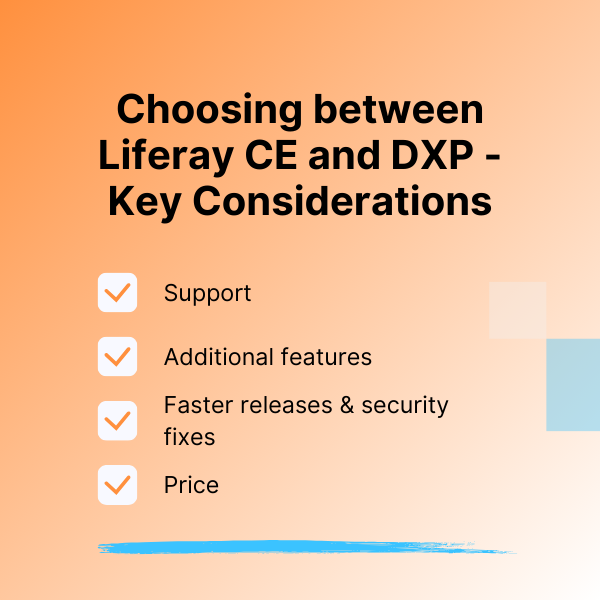
- Containing everything that CE has
- Containing some features which CE does not
- Having a support for the product
- Different release schedule & security fixes
While we won't go into the details of what Liferay CE has, I'll try to give you more details about these points: additional functionalities, support and release schedule.
Functionalities existing only in Liferay DXP
While I won't go through all functionalities, I will cover important ones. The whole list, as mentioned earlier, is probably not available anywhere publicly, but it can be probably obtained from Liferay sales or partners.
Anyway, the DXP-only functionalities are:
- More search options - similar results, synonym sets, result rankings, learning to rank and more
- Search blueprints - low code feature to interact with Liferay search behavior
- Additional integrations: Salesforce, Mulesoft, Stripe (although if you need Stripe integration you can always try our custom Stripe integration)
- OneDrive integration for documents and media and Office 365 integration for documents edition
- Enterprise databases support: Oracle DB, MS SQL, DB2
- Security features: SAML 2.0, multi factor authentication
- Workflow designer and workflow metrics - workflows are available for both CE and DXP but the DXP has designer which lets you nicely manage the workflows, also you get more options for managing the tasks
- Analytics, custom events tracking, content performance analytics, assets tracking - generally different analytics tools
- Audit framework - although the events are saved also in CE the DXP version gives you some extra functionalities like checking the events in UI or exporting them
- A/B testing - A/B testing of an experience of a page with custom goals like bounce rate, click rate etc
- Commerce forecasts, alerts, products recommendations
- A few more small features, not really important for decision making
Is it a lot? Well it depends. It is a lot but looking at the amount of functionalities you get in Liferay CE you can easily say that it is not a lot. These are basically enterprise additions to CE. Some of them could be easily replaced by custom development while others would require more effort.
Important thing to consider is that some of the functionalities require ADDITIONAL licenses. So paying for DXP will not give you everything from the list. For example most of the search related things are under "Liferay Enterprise Search" subscription
We will cover the decision making part later where I'll try to give you more details when it is worth to consider DXP, looking at both functionalities and other things.
Support
Liferay DXP has a dedicated support team which is available for paid customers. If I had to choose one thing which is the most worth paying for it would probably be the support. Why? Let me explain: As mentioned earlier there are quite a lot of new features but they are, in most cases, not essential. Some of these could be also relatively easily replaced with custom development.
The support on the other hand is something that is essential for some enterprise projects and even if you have your own development team, or agency working for you, you still might want to pay extra for the Liferay support. This is especially popular among bigger companies and in some vulnerable industries like healthcare, insurances, banking sector etc.
Someone might ask: What is the quality of Liferay support? Is it really worth it or are you just paying for the feeling that you are more secure?
The answer of course depends. Based on my own experience and conversations with other developers, it seems that different customers have different experiences. Being a "higher paying customer" can affect the level of support you will get. Another big factor seems to be the region you are in as you get another support team.
Having said that, from my experience the support is quite good. They usually find a way to solve your problem either with a suggestion what you can do or simply with a patch. Patching is quite nice in DXP support: the installation of patches is relatively easy and usually does not bring too much trouble.
Are there issues with support? Yes. To name a few:
- Sometimes you can get a feeling that the support is NOT trying to help but just buy time or get rid of your problem.
- Sometimes you wait for answers WAY too long.
- Sometimes support pushes you to reproduce the issue in vanilla Liferay which not only takes time but is often impossible because of the complexity or the fact you just can't tell when exactly the issue appears and you can't reproduce the circumstances.
Overall, as mentioned earlier, the experience is rather positive.
Release schedule
Liferay DXP has a different release schedule than CE. The exact schedule changes quite often in recent years but currently the CE is released only every year, while DXP has quarterly releases. At the same time DXP gets security fixes more often than CE which of course is another important factor in the decision process.
On the other hand recently there was an announcement at Liferay Devcon 2025 that Liferay CE will change the release frequency (again) to quarterly to match the DXP schedule. This is good news for the CE users.
Pricing
As you can see from previous chapters the DXP is just better. I think no one can argue with that. It contains more features, more security fixes and support.
Why aren't we all using DXP then? Well I suppose we all can answer that question: the price.
And here comes another issue with Liferay DXP. I would love to share the prices with you but unfortunately they are not available publicly. So to get prices you either have to be a partner company, talk with Liferay sales or with another company which is a Liferay partner.
Why is this so? Well as far as I know the official reason is that "It is too complex to calculate the price, you need to contact sales to estimate your situation". I don't agree with that. It is not so complicated and Liferay has prices which they could share. They simply don't want to. I understand why it is not though: like many other companies, Liferay wants you to get into contact, to feel the experience and convince you that the product is worth the price. I think no one can blame them for that.
Nevertheless this is probably the most important factor in the decision process. For this article's sake, let's put it this way: it is not cheap to use Liferay DXP. On the other hand there are not many competitors and in Java world there are even less of them. Some of the big competitors like AEM can be even more expensive. The price also might feel differently depending on the region you are in. Costs of developer or development team is completely different in US, Poland or India. That's of course makes the comparison much different depending on the country you are in.
A note on Liferay DXP Cloud
There is also a product built on top of Liferay DXP called Liferay DXP Cloud. It's basically "Liferay managed by Liferay" - a hosted solution where Liferay takes care of the infrastructure. As far as I know there are no additional functionalities in the cloud version. It is actually the opposite: some functionalities are limited for security reasons (like groovy scripts for example). This topic deserves its own article, so I won't go into more details here.
Migrating from CE to DXP
A common question is: what if we start with CE and later want to switch to DXP? The good news is that migrating from CE to DXP is relatively straightforward. The codebase is essentially the same, so your custom code should work without major changes.
That said, you should still plan for some regression testing - similar to what you would do during a version upgrade. In fact, the best approach is often to combine both: when you're upgrading to a new Liferay version anyway, that's the perfect time to also switch from CE to DXP. This way you only go through one testing cycle instead of two.
When should I choose one or another?
Well the answer could be as simple as: if you can afford it, choose DXP.
The truth is much more complicated though. I would say that the decision should be based on the following factors:
- How much time do you spend on Liferay bugs - this is where you could use the support
- How much do you want to base your solution on out of the box solution vs custom development - the more you want to use low code solutions the more DXP might make sense. The more you are just creating custom React components and putting them on pages: the less value in DXP you will get.
- How important is the support for your company security policy
- What kind of data you want to store in Liferay: the more confidential data the more important are the security fixes, on the other hand if your portal is public anyway it might not be that important factor
Some practical examples
To make it more concrete, here are a few scenarios:
- Startup building a customer portal with limited budget → CE is a great choice. You get a powerful platform for free, and you can always migrate to DXP later if needed.
- Bank or healthcare company needing audit compliance and official support → DXP makes sense. The support, security fixes, and audit framework will be valuable for compliance requirements.
- Agency building solutions for multiple clients → Consider DXP if your clients might need official support. Otherwise CE works well, especially if you have experienced Liferay developers.
- Company heavily using custom React/Angular components → CE might be enough. If most of your functionality is custom anyway, you won't benefit much from DXP-only features.
- Enterprise needing Oracle DB or SAML integration → DXP has these out of the box, but they can also be implemented custom. For example, we created a custom database connector for a customer migrating from DXP back to CE. It's a matter of cost: buying DXP vs custom development.
- Organization with an existing Liferay portal (3–7 years old), reassessing their licensing → This is one of the most common scenarios we encounter. The right move is to start with an honest audit: which DXP-only features do you actually use in production? How many support tickets have you raised in the last 12 months, and were they resolved in a way that justified the cost? Many organizations discover they are paying for DXP but running almost entirely on features available in CE. That doesn't automatically mean switching to CE is right - but it should inform the conversation with Liferay sales and your renewal decision.
Price considerations
I also think different companies from different countries will look at the price completely differently. For example, the price for a US company will be relatively much more acceptable than for a company in Poland.
From my experience, the main factors that drive DXP pricing are:
- Number of production instances - a clustered production environment (multiple nodes) is counted differently than a single instance
- Number of non-production environments - staging, QA, dev environments each add to the cost
- Support tier - faster response times and higher SLAs come at a premium
- Additional feature licenses - for example Liferay Enterprise Search is a separate subscription on top of the base DXP price
Understanding your actual footprint across these dimensions is the first step before you can evaluate whether DXP pricing makes sense for your situation - or whether you are overpaying for what you actually use.
Conclusion
While Liferay keeps the DXP and CE differences and DXP prices a secret I think it is important to share such comparison. Especially that during the last years we have been asked this question multiple times.
We have also seen company projects which changed in all possible directions:
- Moved from Liferay DXP back to CE
- Moved from CE to DXP
- Stayed on CE forever and were happy about it
The right answer depends on your specific situation - and an honest audit of what you actually use is worth doing before your next renewal.
If you are unsure which option fits your case, or want a second opinion before signing anything with Liferay sales, feel free to reach out. We have helped organizations on both sides of this decision and have no stake in which one you choose.